Introduction
Lyophilised (freeze-dried) peptides are the gold standard for research applications because of their stability, long shelf life, and ease of storage. However, before they can be used in an experiment, they must be reconstituted — dissolved in a suitable solvent to create a working solution. Done incorrectly, reconstitution can degrade the peptide, introduce contamination, or produce inaccurate concentrations.
This guide covers everything a researcher needs to know about reconstituting lyophilised peptides properly, including solvent selection, step-by-step procedure, concentration calculations, and storage of reconstituted solutions.
What You Will Need
Before starting, ensure you have the following materials ready: the lyophilised peptide vial, bacteriostatic water (BW) or sterile water depending on your application, a sterile 1mL or 2mL syringe, sterile needle (23–27 gauge), alcohol swabs, and a clean working area ideally under a laminar flow hood.
Step 1: Allow the Vial to Reach Room Temperature
Remove the peptide vial from cold storage (refrigerator or freezer) and allow it to reach room temperature before opening. This prevents condensation from forming inside the vial when it is opened, which can introduce moisture and accelerate degradation. This step typically takes 15–30 minutes. Do not use a heat source to speed the process.
Step 2: Choose Your Reconstitution Solvent
Solvent selection is critical and varies depending on the peptide’s chemical properties. The most common options are:
Bacteriostatic water (BW): This is the preferred solvent for most research peptides. BW contains 0.9% benzyl alcohol, which acts as a preservative and extends the usable life of the reconstituted solution to 4–6 weeks when refrigerated. Peptifly supplies bacteriostatic water specifically for this purpose.
Sterile water: Suitable for immediate single-use applications only. Reconstituted solutions using sterile water should be used within 24–48 hours and kept refrigerated.
Acetic acid (0.1%–1%): Some hydrophobic peptides (such as those with strongly basic sequences) dissolve poorly in water. For these, a dilute acetic acid solution is typically recommended before diluting to the final concentration with BW or PBS.
When in doubt about solvent compatibility, consult the peptide’s technical datasheet.
Step 3: Calculate the Volume of Solvent Required
To achieve a specific concentration, use this formula:
Volume of solvent (mL) = Amount of peptide (mg) ÷ Desired concentration (mg/mL)
For example: if you have a 10mg vial and want a concentration of 2mg/mL, add 5mL of solvent. If you want 1mg/mL, add 10mL. It is good practice to prepare a more concentrated stock solution (e.g., 5mg/mL) and dilute further for working concentrations, as this minimises the number of freeze-thaw cycles.
Step 4: Reconstitute the Peptide
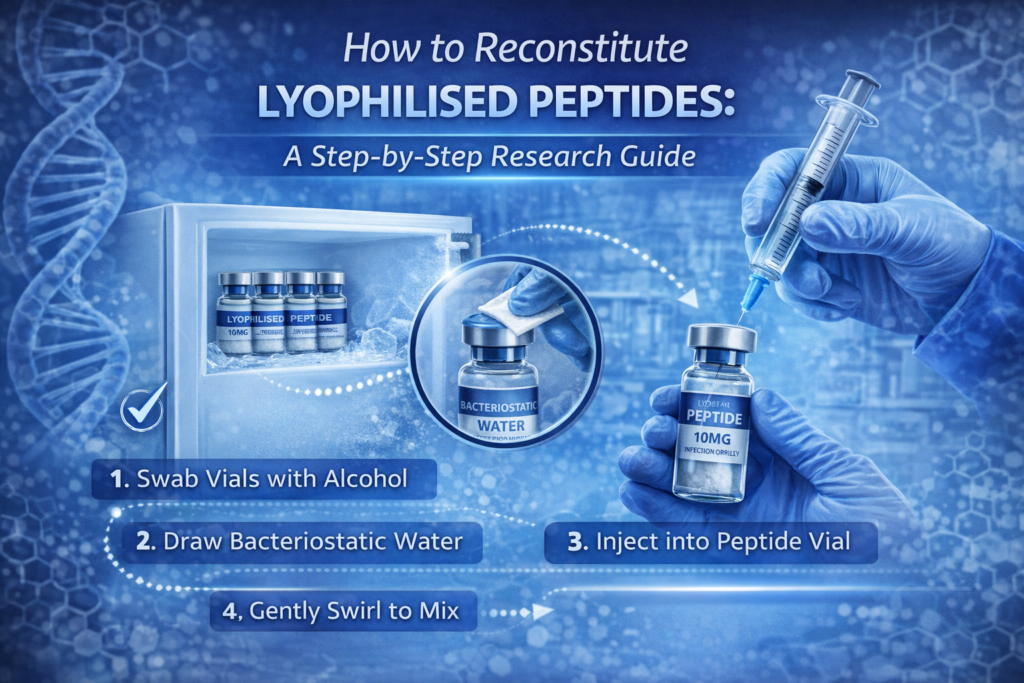
Using an alcohol swab, clean the rubber stopper of the peptide vial and the bacteriostatic water vial. Draw the appropriate volume of BW into your syringe, then slowly inject it along the side of the peptide vial — do not inject directly onto the lyophilised cake, as this can cause foaming and mechanical degradation of the peptide. Gently swirl the vial (do not shake or vortex) until the powder is fully dissolved. The solution should appear clear; if it is cloudy or particulate, do not use it.
Step 5: Label and Store
Immediately label the vial with the peptide name, concentration, date of reconstitution, and your initials. Store reconstituted peptides at 2–8°C (refrigerator temperature) for short-term use or at -20°C for longer-term storage. Avoid repeated freeze-thaw cycles by aliquoting your stock solution into single-use portions before freezing.
Common Mistakes to Avoid
Injecting solvent directly onto the peptide cake — always inject along the vial wall. Shaking the vial — gentle swirling only, never vortex. Using tap water or saline without checking compatibility. Opening a cold vial directly from the freezer — always allow to warm to room temperature first. Storing reconstituted peptides at room temperature — always refrigerate or freeze.
Bacteriostatic Water vs. Sterile Water: Which Should You Use?
For most research purposes involving multiple sessions of use from the same vial, bacteriostatic water is the clear choice. The benzyl alcohol preservative inhibits microbial growth and extends shelf life significantly compared to sterile water. Sterile water is best reserved for applications where benzyl alcohol would interfere with the assay or for single-use preparations. Peptifly’s bacteriostatic water (2mL vials) are specifically formulated for research peptide reconstitution.
Concentration and Dilution Reference Table
For a 10mg peptide vial: adding 1mL gives 10mg/mL; adding 2mL gives 5mg/mL; adding 5mL gives 2mg/mL; adding 10mL gives 1mg/mL. For a 5mg vial: adding 1mL gives 5mg/mL; adding 2.5mL gives 2mg/mL; adding 5mL gives 1mg/mL. Always confirm your target concentration before preparing the solution.
Frequently Asked Questions
How long can I store a reconstituted peptide?
When reconstituted with bacteriostatic water and stored at 2–8°C, most peptides remain stable for 4–6 weeks. For longer storage, aliquot and freeze at -20°C. Avoid repeated freeze-thaw cycles.
Can I use normal saline to reconstitute peptides?
Normal saline (0.9% NaCl) can be used for some peptides but is not suitable for all sequences, particularly those sensitive to salt concentration or with pH requirements. Bacteriostatic water is the safer general-purpose choice.
What if the peptide doesn’t fully dissolve?
Try adding a small volume of 0.1% acetic acid first, then top up with bacteriostatic water. Gently warming the solution (do not exceed 37°C) may also help. If the peptide still does not dissolve, consult the supplier’s technical support.
Where can I buy bacteriostatic water for peptide reconstitution?
Peptifly supplies 2mL bacteriostatic water vials, formulated specifically for research peptide use. Browse our shop at peptifly.com/shop.
Why should I avoid shaking the peptide vial?
Mechanical shaking can cause foaming and may physically disrupt peptide bonds or secondary structures, leading to aggregation or degradation. Always swirl gently instead.
Disclaimer: All peptides sold by Peptifly are strictly for research and laboratory use only. This article is for informational purposes only.