Introduction
Proper peptide storage is one of the most overlooked aspects of research, yet it directly impacts compound integrity and experimental validity. Storing peptides incorrectly can lead to degradation, loss of activity, and wasted resources. This guide covers the key principles of peptide storage, the differences between refrigeration and freezing, and how to maximise shelf life for both lyophilised and reconstituted compounds.
Understanding Peptide Degradation
Peptides degrade through hydrolysis (water attacking peptide bonds), oxidation (particularly of methionine, cysteine, and tryptophan residues), aggregation, and enzymatic contamination. Temperature, moisture, light, and repeated freeze-thaw cycling all accelerate these processes.
Lyophilised Peptides: Storage Conditions
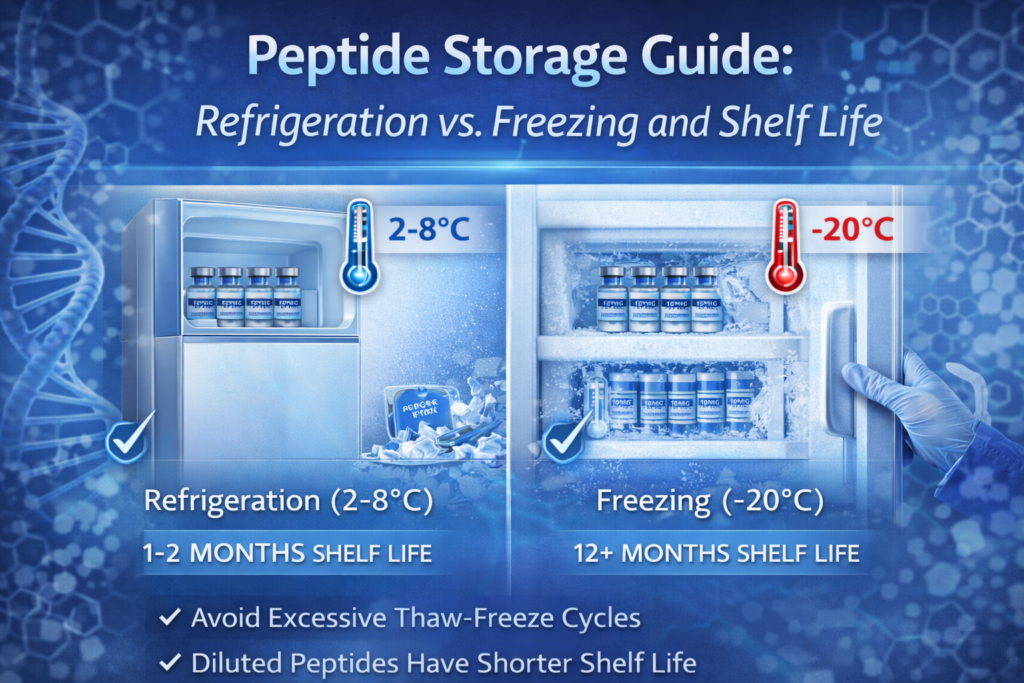
Lyophilised (freeze-dried) peptides are significantly more stable than reconstituted solutions because they contain virtually no moisture. Short-term (up to 6 months): Store at 2–8°C in a refrigerator, sealed away from light and humidity. Long-term (6 months to 2+ years): Store at -20°C in a laboratory freezer. Some sensitive peptides benefit from -80°C storage. Always keep lyophilised vials sealed and use desiccant sachets in storage containers for added protection.
Reconstituted Peptides: Storage Conditions
Once reconstituted, peptides are significantly more vulnerable. With bacteriostatic water: Store at 2–8°C, use within 4–6 weeks. With sterile water: Store at 2–8°C, use within 24–48 hours. For extended storage: Aliquot into single-use volumes and freeze at -20°C.
Refrigeration vs. Freezing
For lyophilised peptides, freezing at -20°C is superior for long-term stability. For reconstituted peptides, refrigeration at 2–8°C is sufficient for short-term use (days to weeks), while aliquoted freezing is needed for longer storage. The key variable is your timeline: refrigerate for 4–6 week use, freeze for longer.
Freeze-Thaw Cycling
Each freeze-thaw cycle subjects peptides to mechanical stress, concentration changes, and oxidative damage. For most peptides, 3–5 cycles is the practical maximum before measurable degradation occurs. Prepare working solutions fresh from frozen stock, or use bacteriostatic water and refrigerate rather than repeatedly freezing and thawing.
General Best Practices
Return vials to storage promptly after use. Keep vials tightly sealed. Use siliconised or low-binding tubes if peptide adsorption is a concern. Label all vials clearly with name, concentration, date, and storage conditions.
How Peptifly Protects Peptide Integrity
Peptifly ships all lyophilised peptides in temperature-controlled packaging (ice shipping) to ensure integrity during transit across Europe. Same-day dispatch before 2PM minimises time in the logistics chain. Browse our full range at peptifly.com/shop.
Frequently Asked Questions
How long do lyophilised peptides last?
When stored at -20°C, lyophilised peptides typically remain stable for 2 years or more. At 2–8°C, stability is generally 6–12 months.
Can I store peptides at room temperature?
For 1–2 days in sealed lyophilised form, room temperature is acceptable. For longer periods, refrigerate or freeze. Reconstituted peptides should never be stored at room temperature.
What is the best temperature for peptide storage?
-20°C for long-term lyophilised storage. 2–8°C for short-term reconstituted solutions. -80°C for particularly sensitive compounds.
Disclaimer: All peptides sold by Peptifly are strictly for research and laboratory use only. This article is for informational purposes only.