Introduction
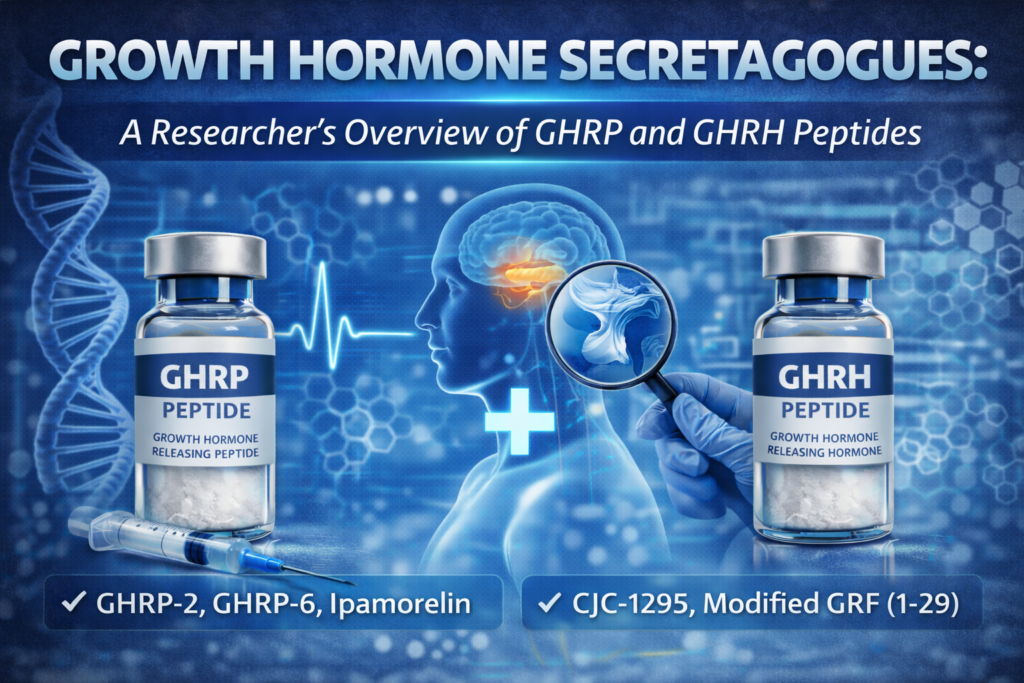
Growth hormone secretagogues (GHSs) are among the most widely researched peptide classes in modern endocrinology and metabolic science. These compounds stimulate the pituitary gland to release growth hormone (GH), either by mimicking growth hormone-releasing hormone (GHRH), acting on the ghrelin receptor (GHSR), or both. This guide provides an overview of the key secretagogue classes and the research peptides in Peptifly’s catalogue that fall within this category.
GHRH Analogues
GHRH analogues mimic the natural growth hormone-releasing hormone produced in the hypothalamus. They stimulate pulsatile GH release from the anterior pituitary. CJC-1295 (No DAC) is a modified GHRH analogue with a short half-life (approximately 30 minutes), producing a pulse of GH release that closely mimics natural physiology. Tesamorelin is a synthetic form of GHRH and is one of the most studied GHRH analogues in clinical and research contexts, with a substantial body of published data on its effects on growth hormone secretion and body composition.
GHRPs (Growth Hormone Releasing Peptides)
GHRPs act on the ghrelin/GHSR receptor, a distinct pathway from GHRH. They also stimulate GH release and are often combined with GHRH analogues for synergistic effects in research. Ipamorelin is one of the most selective GHRPs available, with high specificity for the GHSR receptor and minimal effects on cortisol and prolactin compared to older GHRPs. This selectivity makes it a useful research tool for studying the ghrelin pathway in isolation.
The CJC-1295 No DAC / Ipamorelin Combination
The combination of a GHRH analogue with a GHRP is well-established in the research literature. GHRH analogues amplify the pituitary’s GH output, while GHRPs increase the number of cells releasing GH. Together, they produce a synergistic effect on total GH secretion. Peptifly offers CJC-1295 No DAC / Ipamorelin as a pre-blended compound (10mg vial) for researchers studying this combination.
MOTS-C: A Mitochondrial Peptide with Metabolic Activity
MOTS-C is a peptide encoded in the mitochondrial genome and represents a distinct class from classical GH secretagogues. Research suggests MOTS-C plays roles in metabolic regulation, energy homeostasis, and insulin sensitivity. It has attracted significant scientific interest as a potential modulator of metabolic diseases and is available from Peptifly for research use.
Key Research Considerations
When researching GH secretagogues, important variables include the dosing interval (pulsatile vs. continuous), combination protocols, downstream GH and IGF-1 measurements, and potential effects on glucose metabolism. All Peptifly peptides are lyophilised, independently tested for 99%+ purity, and dispatched from EU warehouses with cold-chain packaging. Browse our full catalogue at peptifly.com/shop.
Frequently Asked Questions
What is the difference between GHRH analogues and GHRPs?
GHRH analogues mimic the hypothalamic signal that stimulates pituitary GH release. GHRPs act on the ghrelin receptor, a separate pathway. They are often combined in research for synergistic GH secretion.
Is Ipamorelin selective?
Yes. Ipamorelin is highly selective for the GHSR receptor with minimal effects on cortisol or prolactin, making it a cleaner research tool compared to older GHRPs like GHRP-6.
Where can I buy CJC-1295 No DAC / Ipamorelin in Europe?
Peptifly supplies CJC-1295 No DAC / Ipamorelin as a pre-blended 10mg vial with EU dispatch and independent COA verification. Browse at peptifly.com/shop.
Disclaimer: All peptides sold by Peptifly are strictly for research and laboratory use only. This article is for informational purposes only.