Overview of CJC-1295
CJC-1295 is a synthetic analogue of growth hormone-releasing hormone (GHRH) that has been modified to improve its pharmacokinetic profile compared to native GHRH, which has a half-life of only 7 minutes in vivo. The compound is commercially available in two forms that differ significantly in their pharmacokinetics and research applications: CJC-1295 Without DAC (No Drug Affinity Complex) and CJC-1295 With DAC.
CJc-1295 No DAC (Modified GRF 1-29)
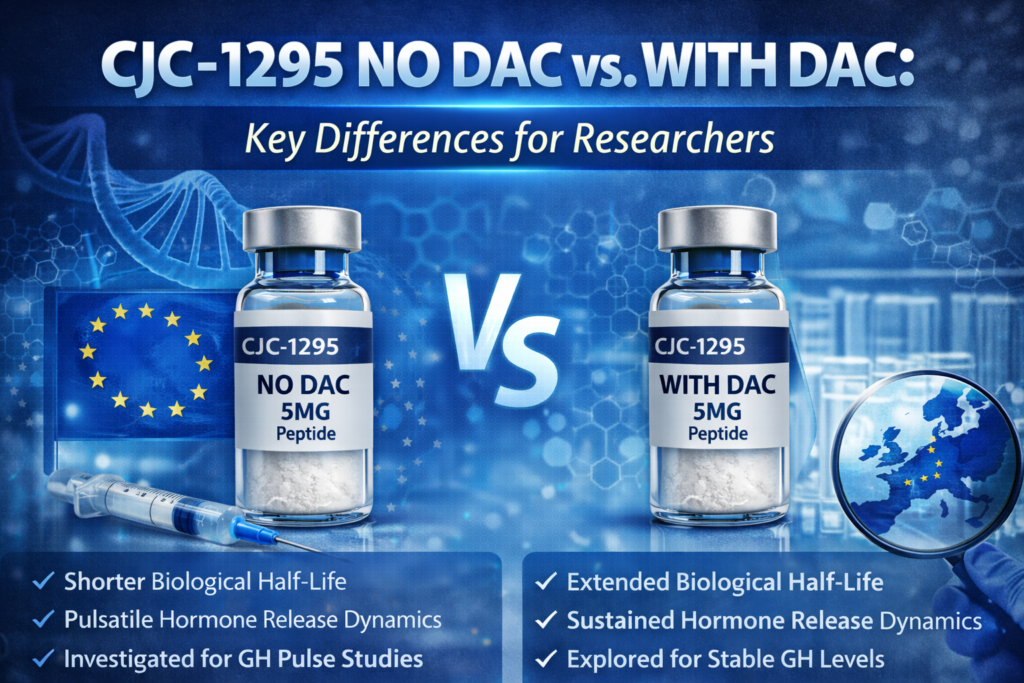
CJC-1295 No DAC, also referred to as Modified GRF 1-29 or Mod GRF 1-29, is a 29-amino acid peptide representing the N-terminal active fragment of GHRH, modified at four positions to resist enzymatic degradation. These modifications extend its half-life from approximately 7 minutes to roughly 30 minutes, producing a distinct GH pulse that closely mimics the natural pulsatile release pattern of GH from the pituitary. This makes CJC-1295 No DAC a valuable research tool for studying GH secretion kinetics and for protocols where preserving physiological GH pulsatility is important.
CJC-1295 With DAC
CJC-1295 With DAC incorporates a Drug Affinity Complex (a lysine-maleimide linker) that allows the peptide to covalently bind to serum albumin in the bloodstream. This dramatically extends its half-life to approximately 6–8 days, creating sustained elevation of GH release rather than discrete pulses. While this property may be useful in certain long-acting therapeutic development models, it fundamentally alters the GH secretion pattern, moving away from natural pulsatility towards continuous elevation.
Research Implications of the Difference
The choice between No DAC and With DAC depends entirely on the research objective. For studies requiring physiological GH pulse mimicry or short-acting GHRH agonism, CJC-1295 No DAC is the appropriate tool. For research into sustained GH elevation, long-acting GHRH analogues, or pharmacokinetic modelling of albumin-binding strategies, CJC-1295 With DAC is more relevant. The two forms are not interchangeable in experimental design.
Combination with Ipamorelin
CJC-1295 No DAC is commonly studied in combination with Ipamorelin, a selective GHRP (ghrelin receptor agonist). The two compounds operate through distinct receptor pathways (GHRH receptor vs. GHSR) and demonstrate synergistic effects on GH release in research models. Peptifly offers a pre-blended CJC-1295 No DAC / Ipamorelin combination (10mg vial) for researchers studying this protocol.
Where to Source in Europe
Peptifly supplies CJC-1295 No DAC / Ipamorelin in 10mg blended vials with EU dispatch, independent purity verification (99%+), and temperature-controlled delivery. Browse at peptifly.com/shop.
Frequently Asked Questions
Is CJC-1295 No DAC the same as Modified GRF 1-29?
Yes. CJC-1295 No DAC and Modified GRF 1-29 (Mod GRF 1-29) refer to the same compound: the four-substituted, albumin-binding-free form of the GHRH 1-29 fragment.
Which is better for research: No DAC or With DAC?
Neither is universally “better” — it depends on your research question. No DAC mimics natural GH pulsatility; With DAC provides sustained elevated GH release.
Disclaimer: All peptides sold by Peptifly are strictly for research and laboratory use only. This article is for informational purposes only.