What Is a Peptide Certificate of Analysis?
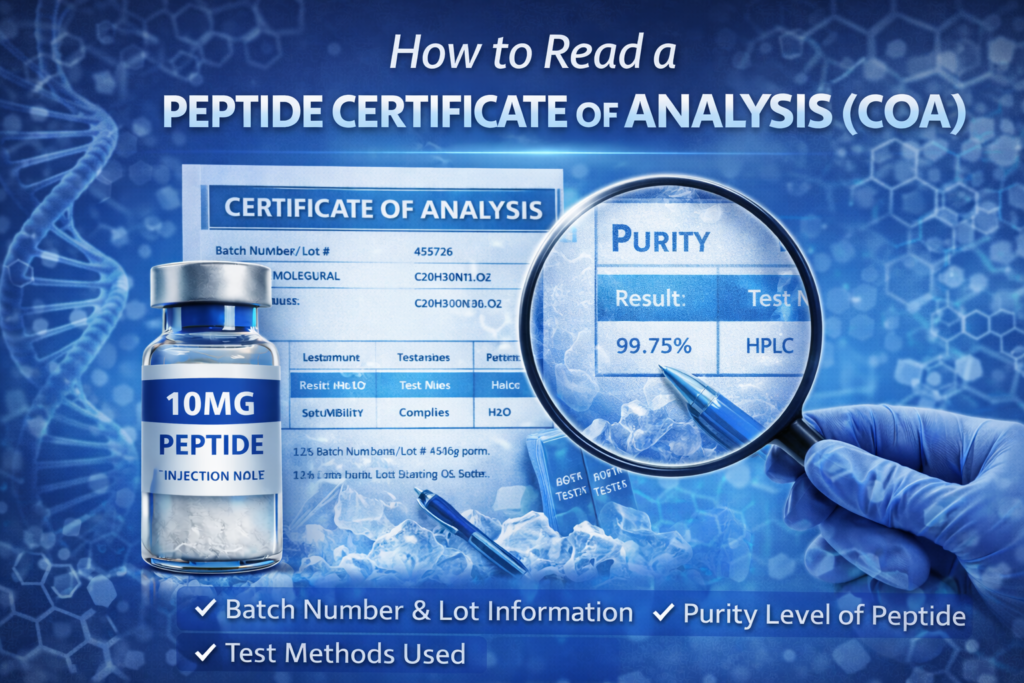
A Certificate of Analysis (COA) is a document issued by an accredited analytical laboratory confirming the identity, purity, and quality of a specific peptide batch. It is the primary quality assurance document that separates reliable peptide suppliers from those selling unverified compounds. Understanding how to read and verify a COA is an essential skill for any serious researcher.
Key Sections of a Peptide COA
Compound Name and Sequence: The COA should clearly state the peptide name and, ideally, its amino acid sequence. This confirms you have received the correct compound.
Batch/Lot Number: A unique identifier for this specific production batch. Match this number to the label on your vial. If they do not match, something is wrong.
HPLC Purity: High-Performance Liquid Chromatography (HPLC) separates the peptide from impurities and measures the area under the peak as a percentage. Look for 99%+ purity for serious research applications. Anything below 95% is unsuitable for most experiments.
Mass Spectrometry (MS/ESI): Confirms the molecular weight of the peptide matches the theoretical molecular weight of the intended sequence. This verifies the compound’s identity, not just its purity.
Test Date: COA results should be recent and batch-specific. Be cautious of suppliers showing COAs dated years ago or not linked to a specific lot number.
Issuing Laboratory: The COA should identify the third-party laboratory that conducted the testing. Independent third-party testing is far more credible than in-house analysis.
HPLC Chromatogram Interpretation
The HPLC chromatogram shows peaks corresponding to different compounds detected in the sample. The main peak represents your target peptide. The purity percentage is calculated as the area of the main peak divided by the total area of all peaks. Ideally, there should be one dominant peak with minimal or no secondary peaks. Multiple significant secondary peaks indicate the presence of impurities, by-products, or degradation products.
Mass Spectrum Interpretation
The mass spectrum should show the molecular ion peak corresponding to the theoretical molecular weight of the peptide. Many peptides appear as multiply-charged ions ([M+2H]2+, [M+3H]3+ etc.) in electrospray ionisation. Each detected mass divided by its charge state should give the same value matching the theoretical mass.
Red Flags to Watch For
No batch/lot number on the COA. COA not linked to the specific product you ordered. No third-party testing laboratory identified. HPLC purity below 98%. Mass spectrum showing wrong molecular weight. COA dated more than 18 months ago. Supplier refuses to provide COA on request.
How Peptifly Handles Quality Control
Every Peptifly batch is independently tested by a third-party accredited laboratory. COA results are published on our website and linked to specific batch numbers. We maintain a 99%+ purity standard across our entire catalogue. Access our test results at peptifly.com/shop.
Frequently Asked Questions
What purity should I look for in a peptide COA?
For most research applications, 98%+ purity is the minimum. For high-precision experiments, 99%+ is recommended to minimise interference from impurities.
Can I trust in-house COAs?
In-house testing carries an obvious conflict of interest. Always prefer COAs from independent accredited third-party laboratories.
How do I match my vial to its COA?
Check the batch/lot number on the vial label and match it to the same number on the COA document. They should be identical.
Disclaimer: All peptides sold by Peptifly are strictly for research and laboratory use only. This article is for informational purposes only.